Table of Contents
Your Customer Might Find the Answer Without Visiting Your Website
Picture this.
Someone searches:
“Best bookkeeping service for a growing business.”
A few years ago, the goal was simple.
Get your website ranking.
Get the click.
Get the lead.
Now, the searcher might see an AI-generated answer before they see your website.
They may read the key information.
Compare options.
Ask a follow-up question.
Get another answer.
And leave without clicking a single website.
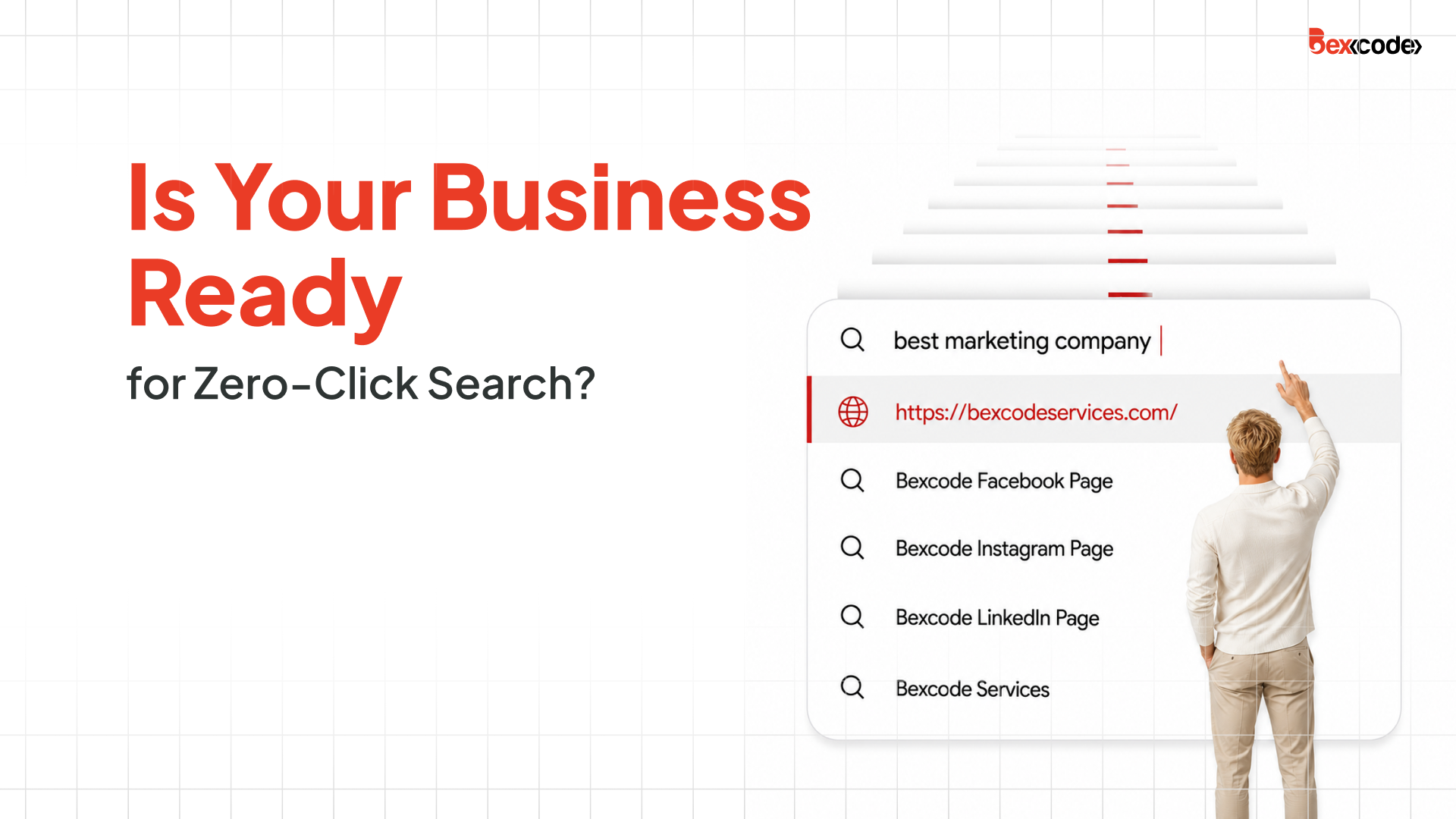
That’s Zero Click Search.
And no, this doesn’t mean your SEO is suddenly useless.
It means the job has changed.
The question is no longer just:
“How do we get more clicks?”
It’s also:
“When people get the answer without clicking, are we still part of it?”
Zero-Click Search Isn’t New. But AI Is Making It Harder to Ignore.
Google has been answering questions directly on the results page for years.
Weather.
Definitions.
Directions.
Sports scores.
Quick facts.
But AI has made the experience much more conversational.
People can now ask longer questions, compare options, add context, and keep asking follow-up questions without starting over.
According to a 2024 Datos and SparkToro study, 58.5% of Google searches in the US ended without a click, while only 360 out of every 1,000 searches resulted in a click to the open web. (SparkToro)
That doesn’t mean 58.5% of your potential customers are gone.
It means clicks are no longer the only thing that matters.
And honestly, they probably shouldn’t have been in the first place.
The Old SEO Question Was “How Do We Rank?”
The new question is:
“Can Google understand what we know well enough to surface us?”
That is a much bigger challenge.
Let’s say you run a digital marketing company.
Your website has a page called:
“Elevating Digital Possibilities for Tomorrow’s Brands.”
It sounds nice.
But what does it actually mean?
SEO?
Social media?
Web development?
Paid advertising?
AI search has the same problem a confused customer has.
If your business isn’t clear about what it does, who it helps, and why it is credible, you’re making discovery harder than it needs to be.
This is where AI Search Optimization starts.
Not with a secret prompt.
Not with stuffing “AI” into every heading.
With clarity.
The Click Isn’t Always the First Win Anymore
Here’s something businesses need to get comfortable with.
A customer may learn about you before they visit you.
They might first see your business mentioned in:
- An AI Overview
- A Google result
- A review
- A Reddit discussion
- A social post
- A comparison article
- An AI-generated answer
Then they visit your website later.
Or search your brand directly.
Or ask someone about you.
That customer journey is no longer neat.
Google itself says its AI search experiences are creating opportunities for people to ask more complex questions and discover new sources. Google also says visits from AI Overviews can be more engaged, which is why businesses should look beyond raw click volume and measure outcomes such as conversions, signups, and engagement.
That’s an important shift.
Less traffic doesn’t automatically mean less value.
The clicks you do get may be coming from people who already know what they want.
So, What Does Zero Click Search Optimization Actually Mean?
Let’s clear something up.
There is no magic “zero-click SEO” button.
And despite what some agencies may suggest, there isn’t a special secret trick that guarantees your website will appear in every AI Overview.
Google itself is pretty clear about this.
The foundational SEO practices that help websites perform in traditional Search also remain relevant for AI Overviews and AI Mode. Google says there are no additional technical requirements or special optimizations required just to appear in these features. (Google for Developers)
So when businesses ask how to optimize for AI search, the answer is refreshingly unsexy:
Make your website useful.
Make it clear.
Make it technically accessible.
Give people something worth referencing.
Your Website Needs to Answer Questions Before AI Has To
This is where many businesses lose visibility.
They create pages about themselves.
But not pages that answer what customers actually want to know.
For example, a bookkeeping company may write endlessly about:
“Why we’re different.”
But potential customers are searching:
- How much does bookkeeping cost?
- When should a small business outsource bookkeeping?
- What’s included in monthly bookkeeping?
- Do I need a bookkeeper or an accountant?
- What bookkeeping mistakes hurt growing businesses?
See the difference?
One is company-centric.
The other is customer-centric.
The future of search is moving towards longer, more specific questions. Google has explicitly noted that users in AI search experiences ask longer and more specific queries, often with follow-up questions.
Your content needs to be ready for those questions.
The Businesses That Win Won’t Be the Ones Creating the Most Content
They’ll be the ones creating the clearest content.
There is already enough content online.
The problem is that much of it says the same thing.
AI doesn’t need another article that rewrites the first five Google results.
Neither does your customer.
If everyone in your industry says:
“We provide innovative, tailored solutions.”
And your website actually explains:
What you do.
Who it’s for.
How it works.
What problems it solves.
You’ve already made yourself easier to understand.
That matters for humans.
It matters for search.
And it matters for AI.
Google’s current guidance for generative AI search repeatedly emphasizes unique, valuable, non-commodity content, along with strong technical foundations and a good page experience.
AI Doesn’t Just Read One Page About You
This part gets overlooked.
Your homepage says one thing.
Your LinkedIn says another.
An old directory listing has outdated information.
Your service pages use vague language.
Your reviews mention services you no longer offer.
Then someone asks AI:
“What does this business do?”
You have essentially given the internet five different answers.
This is why AI search marketing strategy is becoming bigger than just publishing blogs.
Your entire digital footprint matters.
Your website.
Your services.
Your brand messaging.
Your reputation.
Your content.
Your search presence.
The goal is not to say the exact same sentence everywhere.
That would be weird.
The goal is to make sure nothing contradicts the bigger picture.
What Should Businesses Actually Do Now?
If you’re thinking about zero click search optimization, start here.
1. Make your services painfully clear
Someone should understand what you sell within seconds of landing on your website.
2. Answer real questions
Use sales calls, customer emails, reviews, and FAQs as content research.
Your customers are already telling you what they want to know.
3. Fix outdated information
Old pages can still get crawled.
If your business has changed, your website should reflect that.
4. Build useful content around expertise
Don’t publish just to hit a monthly content target.
Give people something they can’t get from a generic AI summary.
5. Don’t ignore technical SEO
Your content still needs to be accessible, crawlable, and indexable.
Google’s guidance for generative AI features remains rooted in these same fundamentals.
6. Measure more than traffic
Look at leads.
Conversions.
Branded searches.
Engagement.
Qualified enquiries.
The future of search may give you fewer casual clicks and more intentional ones.
That isn’t necessarily bad news.
Google AI Overviews Aren’t the Enemy
This is worth saying because there is a lot of panic around AI search.
AI Overviews are not a sign that websites no longer matter.
Google’s AI search experiences still include links to websites and are designed to connect people with relevant sources. (Google Support)
The difference is simple.
You can no longer assume that ranking equals getting clicked.
Your business needs to earn visibility at more stages of the journey.
That is why Google AI Overview optimization services are increasingly becoming part of broader SEO conversations.
Not because AI search has replaced SEO.
But because search behaviour is changing, and businesses need to understand what that means for their visibility.
The Real Future of SEO Isn’t “Zero Click”
It’s Zero Assumption.
You can no longer assume:
Ranking = traffic.
Traffic = leads.
A blog = visibility.
A keyword = a customer.
Search is becoming more complicated.
But the solution isn’t necessarily more complicated.
Be useful.
Be clear.
Be credible.
Be easy to understand.
Google’s own 2026 guidance makes the same broader point: foundational SEO and genuinely helpful content remain central to performing in generative AI search. (Google for Developers)
The businesses that adapt to AI search won’t be the ones trying to game every new feature.
They’ll be the ones building a digital presence strong enough to survive whatever Search looks like next.
Why Bexcode?
Zero-click search doesn’t mean your business has lost the opportunity to be discovered.
It means your visibility needs to work harder.
At Bexcode, we help businesses strengthen their search presence through AI Search Optimization, SEO, content, website development, branding, and digital marketing.
Because being online is one thing.
Being easy to find, understand, and trust is another.
If you’re ready to look at how your business shows up across Google, AI search, and the wider web, talk to our team.
FAQs
What is zero-click search?
It’s when someone gets what they need from the search results without visiting a website.
Does zero-click search make SEO less important?
No. SEO is still what helps search engines find and understand your content.
Can my business appear in AI Overviews?
It can, but there’s no guaranteed placement. Helpful, crawlable, and well-structured content gives you a stronger foundation.
How do I optimize for AI search?
Start with the basics: clear services, useful content, strong SEO, and accurate information across your website.
Should I stop focusing on website traffic?
No. Just don’t treat traffic as the only measure of success. Leads and conversions matter more.
Is AI search the future of SEO?
It’s becoming part of the future of search, but traditional SEO fundamentals are still very much relevant.